Showing posts with label Homemaker. Show all posts

Tuesday, December 20, 2011

Thrifty Furnishings

Using thrift store treasures to decorate my house is one of the simple pleasures I indulge myself in.  I love walking into a store and having no clue what I will come out with, if anything at all.  It has kinda become a game where I see how well I can decorate my house with thriftiness in mind.

As I walked through my house looking for items to take a picture of to post on the blog, I started noticing that 95% of the items in our home have been bought second hand.  Big ticket items like our beds, living room furniture, kitchen table and cabinet were purchased new, but they are filled with second hand touches.

When we moved into our house it was being repainted and I was asked to choose the colors I wanted for each room.  In doing that I also saw other things I wanted to replace before we moved in.  Like always our budget was almost non-existent! When I started talking with Racey about replacing ceiling fans, light fixtures and the kitchen sink I'm sure he was convinced that I had lost my mind.  I reassured him that I would only do what our budget allowed and that I would be patient enough to find all my goodies at thrift stores, estate sales, Craigslist, ect..

Here is a sampling of some of my finds!


This was a towel rack I bought at Goodwill still in the box!  I just assumed it would extend to the same length as the one I had hanging in the bathroom already.  When it turned up to be to short I decided to make it into a jewelry holder.

Towel Bar - $3.00
  I know you must be tired of seeing this as the back drop of most of the pictures I post on here.  This little treasure was also purchased at Goodwill.  It still had the price tag on the bottom and looked to have never been used.  I'm not sure what it was made to do but it serves as a caddy for all my frequently used kitchen items.  I use the kitchen table as an island when prepping meals and when it's time to eat I just grab the caddy and move it to another location so it frees up the table. 

Caddy - $5.00
 I found these the same day as the caddy pictured above.  They had price stickers on the bottom from Garden Ridge.  The taller one was $19.99 and the shorter was $12.99

They seem to be of the same style and that makes me wonder if they came from the same home. 

I paid $4.54 for the taller one and $2.52 for the shorter.  They still have the price written on the bottom from Goodwill!


This clock was being thrown in the trash because it didn't match the new decor in the teachers lounge of a school I worked at.

Clock - Free


I bought this chandelier off Craigslist as we were preparing to move in our house.

Chandelier - $35.00 


This is the matching ceiling fan.

Fan - $50.00
  

This lamp is another item the school was throwing away.  It gives our kitchen the perfect amount of light when we are having a quit candle light dinner or, if the kitchen is shut down for the night, I still like to have a small light on.  It helps the mood of the house!


This little treasure Racey found on the side of the road!  The people were moving and didn't want it.  He stopped and asked if they were throwing it away could he have it.  They said yes and invited him in to look at the other items they didn't want.  He took all of the things and we sold most of them and bought our sink pictured below!  I think it's meant to be a plant stand but I had McClane and his granddad cut wooden shelves for me to use as a solid surface.


Kitchen Shelves - Free


I found this at Goodwill and thought it could hold my necklaces.  Once home I changed my mind!

$ 1.81


This was a garden planter that I found at Goodwill and re-purposed into a kitchen utensil holder.


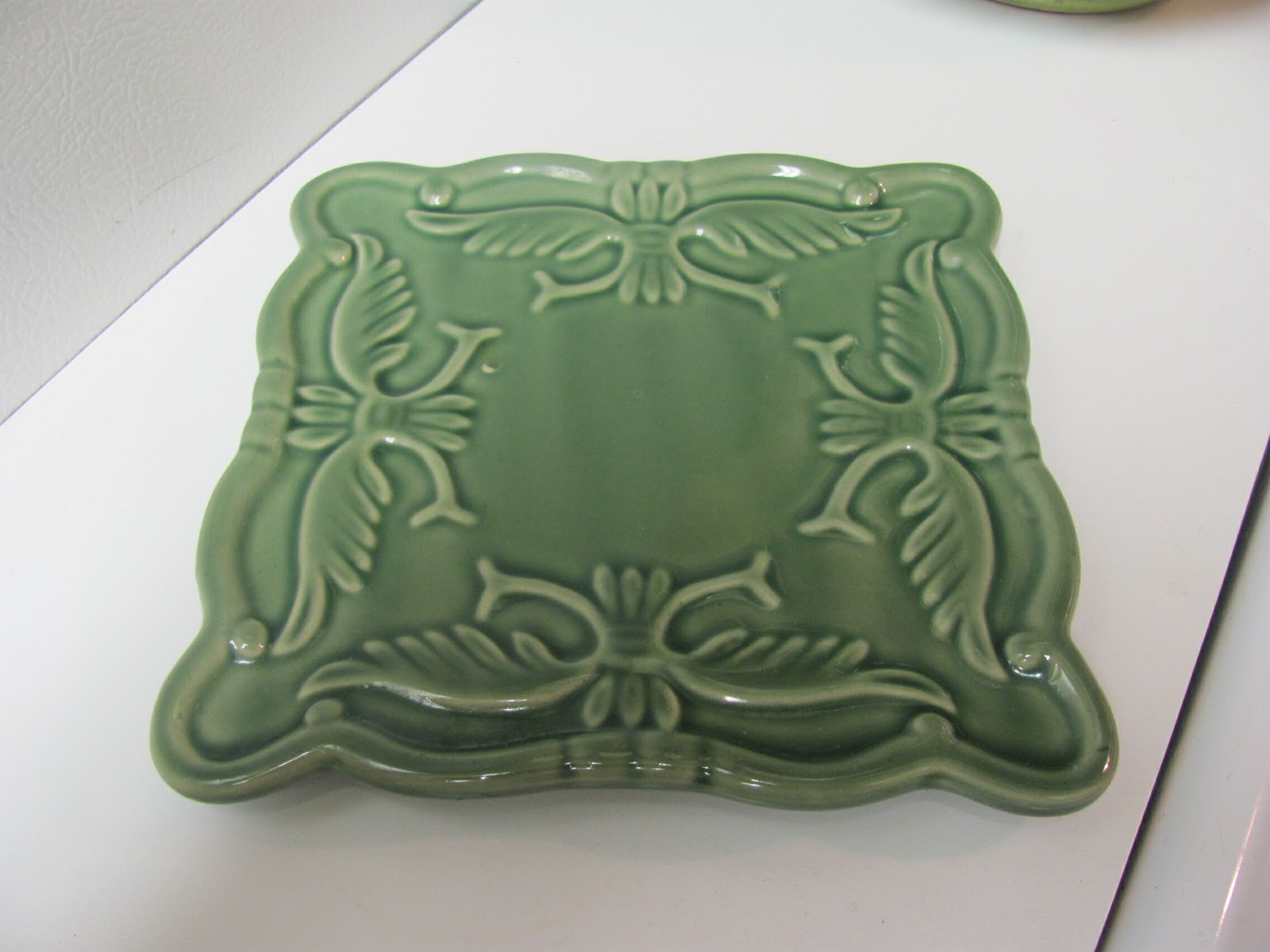
This is a trivet (I think) I like to use it as a spoon rest.
Here are several things from my bathroom.  The toothbrush holder was a pencil holder, the little pink girl at the well is an antique planter, and the hairbrush holder is another planter, who knows what the other dish was made for but as you can see I use it to hold my favorite soap and jewelry.  All these items were found at thrift stores.

Toothbrush holder - $1.51
Hairbrush holder - $1.21
Soap dish - $1.81
Girl at the well - not sure of price


As you can see many of the items that decorate our home have been discarded by others, and that's fine with me

Tuesday, December 6, 2011

Rediscovering the Pressure Cooker

Most ladies I talk with are working mothers and those that don't work outside the home volunteer, home school or take care of grandchildren so their adult children can work.  The one main theme coming from all these ladies is lack of time in the kitchen. Why is this?  We live in the 21st century, we have more modern conveniences than any previous generation.  We have microwave ovens, indoor grills, toaster ovens, blenders, rotisserie ovens,  bread machines, crock-pots, and $400.00 mixers just to name a few!  And somehow we still can't manage to feed our families fresh, non-processed food.

I've always been mystified by the housewives fifty years ago.  How in the world did they raise children, grow a garden, take care of the house, wash, dry and iron all the laundry and have three hot meals a day on the table.  I'm beginning to discover a few of their secrets, one of which is that they had basic kitchen equipment and knew how to use it.


One friend in the kitchen was the pressure cooker.  This piece of equipment allowed you to cook fresh, whole foods in a fraction of time.  Some of you are probably saying "so does the microwave", and I agree, except that the end product doesn't compare.  Most of us use our microwaves to reheat, or cook prepackaged, additive filled junk food, not fresh meat and produce.

This little gem was a staple in the pre and post World War II decades.  It started getting a bad name after the war when the market was flooded with cheap models that were constructed with weak metals.
Cooks held onto their prewar pressure cookers and often several families shared a single cooker. In a time when fuel and food were rationed and shortages were commonplace, the pressure cooker was fast becoming a necessity rather than a mere convenience. In a bulletin to homemakers, the government promoted the formation of "canning circles" to best utilize scarce resources and urged people who owned pressure canners to share them with other families. Warning that "only a few canners will be available for purchase this year," it was suggested that six or more families share each cooker.

Hopefully by now, you can tell what my favorite kitchen tool is at the moment! Yes, my pressure cooker!  The little whistle sound it makes as it cooks is a sound that takes me way back in my childhood.  If your mother or grandmother cooked from scratch then you too know the sound I'm referring to.


I lucked out and found my pressure cooker at Goodwill for $6.86!  It is a Presto 4 quart cooker, and it had all the original parts along with the manual that was dated 1961, which I love!  When I started looking through the manual I was astonished at the cook time it gave me for fresh meat and produce.

Here are a few examples:
  • Beans (Green or Wax)      3-4 minutes
  • Broccoli                            2-3 minutes
  • Carrots (sliced) 3 minutes (whole) 4-8 minutes
  • Potatoes (Baking w/skin)   15 minutes
  • Potatoes (for mashing)       10 minutes
  • Cauliflower (whole) 5 minutes (flowerettes) 2 minutes 
  • Corn (On-the-Cob)            3-5 minutes
  •  Hamburger Patties            5 minutes
  • Meatloaf                           15 minutes
  • Beef Pot Roast                  8-10 per pound
  • Ham, picnic, plain cut        30 minutes
  • Pork Chops, Breaded       12-15 minutes
  • If your family eats dried beans or lentils no more soaking over night just to cook for several hours the next day!    
    • most items cook in 1/2 to 1 1/2 cups of water
As you can see the cooking times are very short.  To think I can come home from a busy day and have fresh green beans in three minutes, or prepare a meatloaf in fifteen is almost crazy to me.  Why would we choose a boxed meal that has no real nutritional value or a minced meat product that is formed into a shape to serve our families when we have such awesome tools to help us cook real food?   

If you don't already own a pressure cooker I would highly recommend putting one on your wish list.  You could try Goodwill, Craigslist, or Freecycle just to name a few.  If your mom or grandmother have one they are not using anymore they would probably love to give it a new home. If all else fails you can buy one new. They now make a model that is totally electric and is so easy to operate a child could do it.  I prefer the older style models that only rely on heat, whether from gas, electric stove, or even a fire pit if it comes to that. If you are purchasing a used one, be sure to check out the rubber seal and safety valve.  There are plenty of websites that sell replacement parts very cheap if any of those items are damaged.  I found several site that actually carry in-stock replacement parts for my 1961 model.

Here are a few website with recipes for pressure cookers Site 1, Site 2, Site 3 which is my favorite due to it having 101 recipes!

I will cook dinner tonight in my pressure cooker and hopefully post pictures on the blog tomorrow if I have time!

Thursday, November 17, 2011

Can You Cook Without Eggs, Milk, or Butter?

Tonight I saw a post of Facebook by one of my friends/family who, by the way, has four children that said   "I have no milk and no cheese!  How do you cook dinner without milk and cheese?"  This gave me such a laugh because I can vividly remember being a young wife and mother and finding myself in the same situation!  Unfortunately for my family, that was before my preparedness skills had been developed.

Having a well stocked pantry can save you in more ways than one.  If you are like us and you are totally busy all day, everyday, then running out to the store for one or two missing ingredients is just a pain.  Many of you have young children and know quite well how inconvenient it is to load the kids up and drive to the store for one or two things, so much so that you would almost rather do without!  What if you could find a happy medium like something that would save you when you realize that you are missing one essential ingredient, like milk, eggs, or butter?

I have the answer for you!  It's dehydrated or powdered substitutes.  I know many of you are turning up your nose at the word 'powdered', but please remember we are using it to cook with, not eat as is.  In stocking my pantry for the unexpected, whether it be the loss of a job, an extra high utility bill, or an unforeseen major car repair, etc., these items are worth their weight in gold when I call them into use.


In my personal research and preparation I came across a company, Shelf Reliance, that sells all the essentials in a long term, shelf stable form which will hold for up to 25 years in most cases!  These items can be costly if you try and use them as everyday essentials, but if they are part of your stockpile or 'back-up' pantry then they are well worth it.  Tonight one of my grown kids turned their nose up at the idea of using powdered milk for their cereal until I told on myself and let them know that I've refilled the milk jug more than once with powdered milk and they didn't even notice!  This is really not my normal MO, but sometimes you just do what you gotta do.  My challenge for you is to look at the staples you use.  If you can find them in a shelf stable version then buy just one of each to begin your stockpile pantry in order to save yourself not only an inconvenient trip to the store, but buy just a little insurance as well.

Sidenote:  We've mentioned this site on one previous occasion on this blog.  In case you missed it, let us know in advance if you intend to actually purchase something from them.  We have a way to get you a discount on the items beyond the normal prices listed on the site.  And, for full disclosure, we have no affiliation or involvement with this site or anything like that, we just happen to think they have wonderful products that are tough to find elsewhere.

Saturday, November 12, 2011

Function vs. Beauty - It Can Be Done!

Function and beauty at the same time!


I'm the type of person who loves a clean, organized house.  I love to wander through the storage section of any store, and looking through a catalog that has endless organizers and containers gives me the *warm fuzzies*.

This can become a pain for the folks around here because everything has to have a home, and if it's not in it's home I get all grumbly.  Let me defend myself for a minute here.  This obsession has come in handy more times than I can count.  At one point in my life I condensed a 3,000 sq. ft. house and five people into a single wide mobile home with room to spare!

I believe organization is key to living a life wherein you take advantage of all your assets and use every item that comes into your home (which follows the main tennent of this blog). No matter the size of your home, if you can't find your stuff and have to buy it again or you are tripping all over your possessions, then that's wasteful.  Have you ever forgotten you had something because it was misplaced or lost?  Have you ever donated or tossed something into the trash because you couldn't find the piece that would make it work?  I have, and that drives me insane!  Just when I get rid of whatever it is, the missing piece turns up... Grrr!


Our house is no different than yours!  It gets trashed and we trip all over ourselves too.  Who wouldn't have a messy home occasionally when there are five adults living in 1050 sq. ft..  This set of photos were taken after my two adult kids (18 & 20) and their significant others spent the night here and then left for work the next morning. They know the rules, so that day I threw away a pair of jeans, a tank top and a pair of shoes.  I know that sounds harsh, but if they can't be bothered to clean up after themselves and they disregard their items enough to leave them on the floor, then the trash is the best place for them.

Our kitchen table can easily become a catch-all, so we try to have folks walk straight to their room before they drop their stuff.  However, that doesn't always work as you can see by this picture. We try though!  Honestly, as I sit here and look at this picture, half the stuff on the table is mine! Shh, don't let my kids hear me say that. ;-)


So let's get organized!

Where do I start you may ask?  My suggestion is to start in the busiest room of the house.  I know for some that might be a scary place to begin, but you will see the biggest difference right from the start which will motivate you to continue.  In our home the kitchen and dining areas see the most traffic so we started there.  Your kitchen should fit your families lifestyle and the way you live.  Most kitchens are designed by people who rarely use the space for anything other than making a cup of coffee or reheating take-out.  I remember that in my first custom built house I let the cabinet maker design the layout of the cabinets.  I was a young wife and mother, and I was naive enough to think that a 'professional' would know better than me.  To my surprise, when the cabinets and counter top were installed (no going back now), I realized that I had NO PANTRY!  What good is a kitchen when you have no place to hold the ingredients you are supposed to cook with?  I asked the company about this, and their answer was that most people just use a few cabinets to hold their canned and boxed goods, and that a separate cabinet to house food was for older style kitchens.  "Oh, you mean back in the day when families use to cook and eat at home?", I thought to myself.  IMHO, that's not a working kitchen, that's a glorified dorm kitchen with the requisite microwave!

So here is where we started.  We reorganized both the kitchen and the dining room to maximize our working space.


I took all the big kitchen items that take up a lot of counter top space and put them on a handy shelf in the garage.  This way I don't have to toss the item but its not eating valuable counter top space.


We had an old kitchen table that was taking up space in the attic, so we brought it to the garage which is right off of the kitchen so it's convenient for use.  We placed the most frequently used items on it and plugged them into a power strip so they're ready to go.  In the summer this is another way we control the heat that a working kitchen generates.


We moved our pantry outside to the garage, and since we buy most things in bulk, this makes it easier to store larger items. (this is a bad pic, we were reorganizing at the time and half the food was on the floor)


  This was our original kitchen pantry which we turned  into an "above ground root cellar" to hold all our fruit and veg as well as the recycle bin.


We have a small spiral staircase that has a little nook of space underneath.  Underneath it we have a recycled plant rack Racey found on the curb of a house where the residents were moving and couldn't be bothered to take it with them.  McClane and his granddad cut wooden shelves to serve as a solid base so I could use the space more efficiently.  This now holds many of my 'go to' items that I use several times a day.


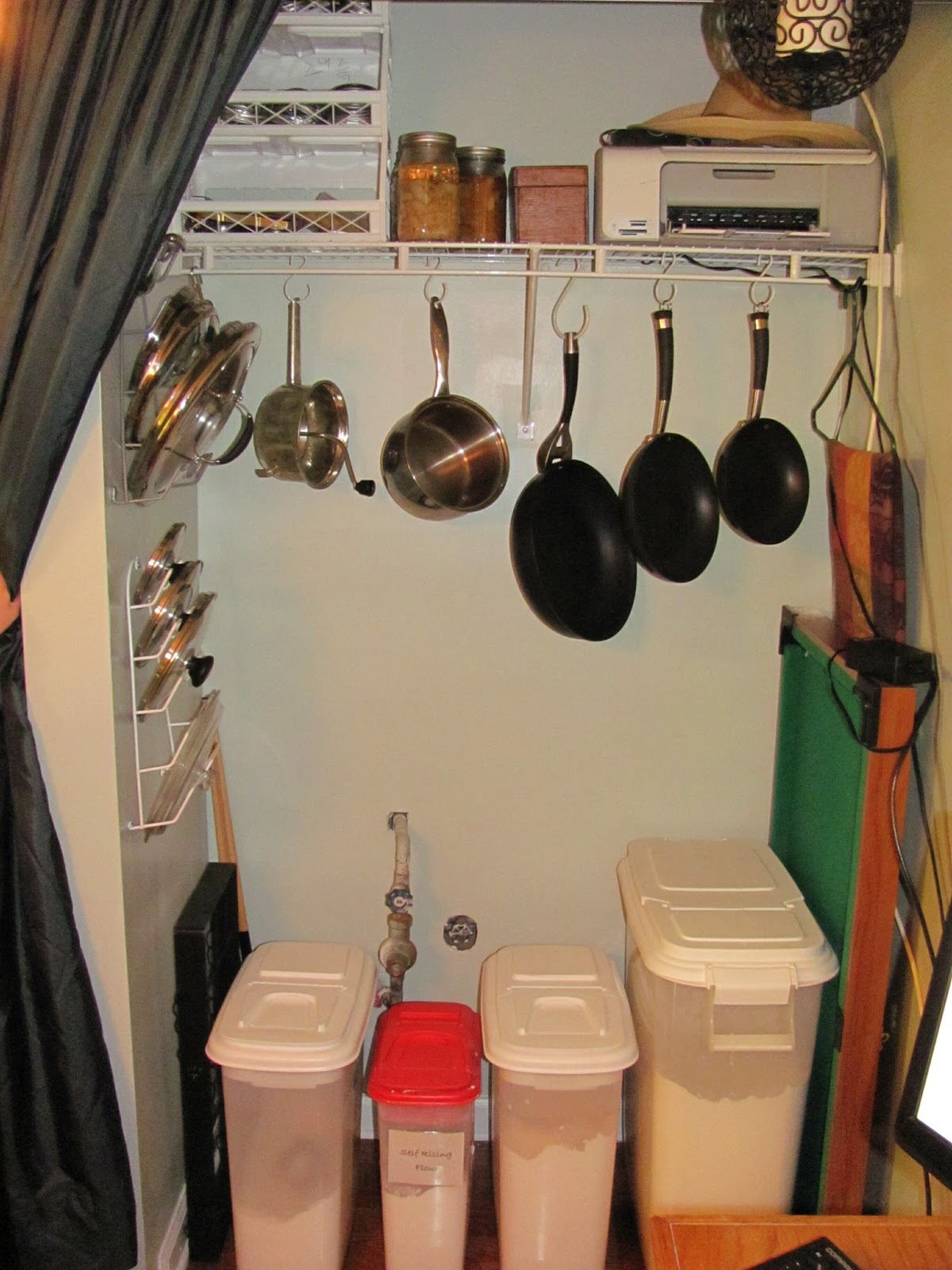
We had a coat closet next to our dinning area.  It had mirrored sliding doors and was just wasted space in my opinion.  So we took the doors off, hung a long curtain in its place, and now it stores our large containers of bread flour, all-purpose flour, self rising flour, and sugar.  I use the old coat rack as a pot rack, and I found lid holders at Goodwill and mounted them on the wall.


Our home is very small and if we can find all this storage and organizational space, I know you will have success as well.  It's all about deciding what things you want to accomplish in each room and start to think out of the box.  The fact that just over 1000 square feet functionally fits the needs of a family of five is proof that you can do whatever you really need to do, and it can look plenty nice at the same time!  Just check the pic at the top for proof!


Friday, November 4, 2011

Home Cooking Saturday - Chuck Roast


Today's home cooked meal is chuck roast.  This is an easy, hands free, and delicious meal.  When I was a young wife the only method of preparation I knew was to cook it in a crock-pot.  That method was fine if I started the roast early in the morning, but if I got a late start then I was out of luck.  The crock-pot has many advantages but speed is not one of them.  The latest method I've come to prefer is to prepare it in the oven.  I know this isn't new in any way, and I knew it could be done this way int he past, but it was always scary "real cooking" to me.  The crock-pot is kinda like microwave cooking.  Just put it in, flip a switch, and your done.  If that's all the more daring you'd like to be... well you can figure that one out on your own.  Here's the super-mega-skeery-real-cooking method:

Line a baking dish with aluminum foil.  Place the meat in the center and toss your roughly chopped sidekick ingredients around it, which in this case are potatoes, carrots, and onions.  Cover generously with salt, pepper, and minced garlic.


Loosely fold the foil over so the top is covered kind of like a tent.  This is so all the good moisture and flavors will be somewhat sealed in and won't just evaporate.


Toss it into the oven and bake at 350 for 2 1/2 to 3 hours or until the internal temperature reaches 165.  If you're a gravy family, remove the meat and vegetables and place it on a serving plate, then just use the remaining liquid to make your gravy.  The gravy can be made a number of ways.  The easiest way I've found is to pour the liquid into a small sauce pan and add about 2 teaspoons of flour or cornstarch and whisk it over medium heat until it thickens.  Depending on how much liquid you had, you may want to add a small amount of milk which will add to the creaminess of the gravy as well as increasing the overall amount of gravy you'll make.  If you feel like you need it, add the milk before you add the flour or starch. 

When it's all finished, this is what you'll end up with:


In my opinion it's just as good as the crock pot method and takes a fraction of the time.

Thursday, November 3, 2011

Passing On The 'Old Ways'

Yesterday was a very busy day for me.  I woke up early and headed to the farm where I picked up 1 1/2 gallons of fresh raw milk.  Then I drove to Loganville and sold 17 Farmer's Market Baskets at our new location which is the little cottage industry I sometimes refer to.  While 17 baskets is a small haul for the amount of time and distance I have to drive to get there, I see it as a starting point.  I am personally so thankful for the benefits my family receives from the baskets that I want to pass it on.


While I was there I had the chance to pass on some of the 'old world' life skills Racey and I are passionate about.  I took the raw milk and taught the family who's home we use as the drop off point how to make butter from the cream in the raw milk.  The kids took turns shaking and laughed and played as if it were a game!  I think that's an important concept in this style of living.  You have to involve the children in the daily chores to make everything work in the long term, but it also needs to be fun so they don't really feel like it's work.  By doing this you're teaching them valuable life skills like being self sufficient and making their own products, but also a responsible work ethic.  The butter isn't going to make itself.  If you want butter then shake some cream!  Forget the tendency to just pop into some big box store and pick something up that you have no clue when or where it was made and from what.


After the butter was finished we had butter milk left and in the mindset of waste not want not, we used it to make a pan of biscuits.  Once again the children were as interested as the mother.  They pulled their chairs up to the counter and watched every single thing I did.  They insisted that the flour tasted good.  The two year old, Corbin, dipped his little fat fingers in the buttermilk and sucked it off till his mama moved the bowl!  I wish I had taken more photos, but with four little ones five and under in age, picture taking wasn't very easy.  After the biscuits were finished cooking, everyone had a hot butter biscuit as a treat.  Yes, it was a TREAT!  The family was as happy to have the hot homemade butter biscuit as if it was something special from the store.

As the last person picked up their basket, the question came up of how to you use real carrots.  I started laughing and thought she was joking at first.  I asked her, "have you never eaten carrots before?", and she replied, "yes, but they are always cut up and ready to eat."  Again I laughed and shook my head.  It's really only funny if you've ever been as modern and spoiled as this.  I have, and when I look back at all the money I wasted on pre-washed, pre-cut, ready to eat convenience foods I realize the joke was on me.  It's silly, I know, but as a society we are being dumbed down when it comes to self sufficiency.  The more knowledge they take from us the more they can make us pay just to eat and survive.  Okay, okay, I'll get down off my soapbox here... maybe ;-)

As I left, I took a fruit and veg basket to my children's grandfather who is by himself now that their grandmother passed away last November.  I hate to use the term ex-father-in-law when referring to family as I have found when you have children even if the marriage doesn't last the family connections do.  He was very grateful for the veg, and we talked about the kids and life for a little while.  When I left he seemed a little happier than when I got there.  It's somehow nice to know that just a little food and companionship cane make a difference.  I had a 1/2 gallon of raw milk that was supposed to come home with me, but knowing who I was visiting and his love of 'old style' living I left the milk with him.  He was really excited about that, and of course then the stories started about how when he was a boy that's all they drank!

I backed out of the driveway and glanced back one more time before driving off and saw him through the kitchen window drinking strait from the jar like a kid!

By the time I made it home it was dark and I had been gone for almost 12 hours.  I was welcomed into a clean house with dinner ready on the stove, and my hubby waiting for me around the fire pit.  For all the hard work it was overall a great day.

Saturday, October 29, 2011

Home Cooking Saturday - Meatloaf

Today's Homecooking Saturday meal is meatloaf.  Meatloaf is one of those dishes that can be prepared countless ways and have countless ingredients.  In our house several people claim they don't like many of the ingredients in traditional meatloaf so I tend to lean towards fewer ingredients. As their taste grow and change I slowly add a few items into the mix.

Here is what I start with:
  • 1 1/2 pounds of lean ground beef
  • 1 1/2 pounds of ground pork
  • Homemade bread crumbs
  • 2 farm eggs
  • 1/2 cup of homemade onion soup mix (dry)
  • Water
  • Ketchup


First I mix the beef and pork until well blended. If you have a free standing mixer this is very helpful, but if not, no biggie.  Just recruit whoever has the biggest, strongest hands in the family.


Next I incorporate all the ingredients listed above.  If your family likes any of the extra ingredients such as whole sliced onions, bell peppers, brown sugar, dry mustard, Italian seasoning, salt, pepper, etc. this is the time to add it.


Since I just blogged about the The Tools of My Trade, I wanted to take a picture of my meatloaf pan. This is a fairly new item that has been added to my toolbox in the last year. I love it!  Notice how it has two pans that nest inside each other. The one on top has holes in the bottom to allow the grease to drain off the meat.  This is  very convenient and reduced the amount of grease in the meat. I also have a Pampered Chef stoneware pan that I have used for 10+ years that was my favorite and still runs a close second to this one.


You might want to lightly grease your pan with a little oil if it's not seasoned well so the loaf doesn't stick to the pan.  Divide the meatloaf into two portions and pack it into the loaf pans.  I used three pounds of meat because I wanted to make two loaves at once and freeze one for a later meal.  This is a really easy way to feed your family a home cooked meal when the time you have to work in the kitchen is just not there!


Lastly you will want to place the meatloaf in a preheated oven @ 350 and bake for one hour.  If your pan doesn't have drainage holes like mine then you'll want to drain some of the grease off as it cooks.  After an hour if you have a meat thermometer you can temp the loaf to verify if it's done in the middle. The temp should be between 165-170 degrees.  If it's not at the proper temp continue to bake until done.


Once it's done I drizzled it with additional ketchup and put it back in the oven to brown or glaze.


Meatloaf is easy to reheat as a leftover.   If you have never tried, a heated meatloaf sandwich the day after it has been cooked you are missing out.  Here are a few different recipes your family might enjoy.


I really hope this meal makes it into your recipe box.  Trust me, your family will love you all the more for it!

Friday, October 21, 2011

Tools of My Trade

Have you ever noticed how men tend to have tons of tools?  It seems like every new project requires a new tool until they reach 55 yrs. old or so, and by that time they have acquired every possible tool under the sun.  It's really no different for the homemaker.  We need special tools to do our job as well.  Have you ever tried to bake a bundt cake without a bundt pan, or peal an entire bushel of apples with out an Apple Peeler Corer Slicer?  I have and let me tell you it's no fun! 

This is a china cabinet I bought to display my nice dishes several years ago.  It became a display case of special items that I wanted to look at but not really touch or use except for twice a year.  As we began to down size and started cooking most everything we eat from scratch I realized how ill equipped my current set up and supplies were.  I had just enough space in the kitchen to get irritated.  Our knife collection consisted of one lonely knife who you had to strike a deal with before it would cut, and a mis-matched set of flaking non-stick cookware.  So I decided to convert my china cabinet into a working unit.  Out came all the "too nice to use" items and in went the things I used everyday, or at least once a week.


As you can see I have many different types of tools in here now.  On the bottom right, are two bowls with different types of flour for biscuit and bread making.  On the top shelf is the apple peeler I mentioned above and the remaining items ranging from colanders to mixing bowls to canning funnels.  I keep a small open dish of salt for easy measuring, and a ton of little things in the flatware divider in the middle.  This is now a useful piece of furniture that assist me in my daily routines.  Our kitchen is a working kitchen so the contents of this cabinet change as often as they need to.


This was not the only conversion in our kitchen.  We decided to make our kitchen table an island.  This was in the middle of the kitchen and living area so we figured it could be used to prep most everything and since we clean as we go, it would be clean and free for use at mealtime.  I placed a container I found at Goodwill in the center and filled it with hand towels, knives, and other prepping equipment.  When we sit at the table I just move the container and we have a dining room table again.

If your kitchen seems like it's not working for you, take some time to think about what you're missing that would make life easier.  If it's tools or utensils, hunt Goodwill, second hand stores, Craigslist, and especially estate sales.   If it's space, think about how you could extend your working area.   We more than doubled our 'kitchen' space by doing just a little re-arranging and re-thinking.  If you make your space work for you, it makes it much more enjoyable to work in your space!

Wednesday, October 19, 2011

Where is all our money going?


How do you know when something is a good deal?  Do you wait for the store to put it on sale?  Do you compare brands, prices, quantity, even different stores?  Or do you just buy what you need and hope the money last till the next pay day?  Several women I know have taken the time to put together a price journal of the items they purchase on a regular basis.  This is a working journal that changes depending on your ability to source better deals, sales and inflation.  We started keeping track of our items in February of this year. Each time I return from the store I save the receipt to log the price I paid for the item in my journal.  This helps me see what is going up and what is going down.  If something is increasing then that is an item I began to actively source somewhere else.  It also becomes an item that I keep my eye open for coupons for and sales of that item.  Sometimes I've already found the lowest price in which case I use coupons and sales to get it for a lower cost, but sometimes the price is just increasing overall. 

See Honey! I'm saving us money by buying in bulk!
Have you ever asked yourself "where is all our money going?"  You know there are no new big ticket items sitting around the house, you haven't gotten a new wardrobe lately, and, heck, you can't even remember the last time you splurged on something other than the really cushy toilet paper!  You are working the same hours, maybe even more, but still you are coming up short.  When you keep a price journal it's easy to see if the culprit is price inflation.  This information is helpful when planning or adjusting your budget.  If you see that your grocery bill has risen 15% in the last six months then you know some other expense is going to have to reduce in order to maintain the same budget. 


In our journey many things have gotten the boot.  We've disconnected our cable television, ditched our cell phones, and severely limited fast food.  These things aren't bad or evil, we simply can't afford them.  Ask yourself... Who are you trying to impress?  I honestly can't say I miss these things... they were just something I was accustomed to.  I grew up on fast food and convenience.  My mom was a young, single mom who worked a full-time job at minimum wage until she was able to move forward a little.  There was literally no time to do anything for herself.  We cleaned our own house, and Saturday was the day it was cleaned from top to bottom with no exceptions.  Quite simply, we were broke.  We ate cheap food, wore used or discounted clothes, and my mom worked her butt off just to keep things going, but somehow she did.

Maybe you're in this situation.  Maybe you're fortunate enough to have a good education and a supportive spouse. Whatever your circumstances are, keeping track of your expenditures is the only way to move forward.  That way you'll know where you stand and how you can continue to move forward.
  

Monday, October 17, 2011

Emergency: Starve or Thrive?


    Since 2008, the U.S., along with the rest of the world, has been in seriously dire financial straits and the view from where we're sitting doesn't look like things will be improving anytime soon.  If anything, the "experts" say we are headed for round two which will be worse than the last three years.  I know a lot of people who have already lost their jobs, cars, homes, credit, savings, and don't have a lot left to lose!  The entire world is on the brink of financial disaster, we are having protests at home, riots abroad, etc. and no one has a solution.

With a high likelihood of difficult financial and sociopolitical times ahead, what are you doing to prepare your family to make it through should things get really tough?


We've had a difficult time addressing all of our concerns here at our house.  If our preparation for 'disaster' was something along the lines of the steps normally taken to prepare for a short term emergency such as a hurricane or even flooding, the issue would be more clear cut.  It would be easy to target specific areas of preparedness, such as having a 72 hour water supply for a hurricane and a few boxes of candles, batteries, and maybe a hand-crank radio along with the requisite stockpiles of food.  However, the approaching storm seems to present a much deeper and wider set of possible problems which, should they hit hard, have a high probability of persisting for a much longer time than a measly three days.

One problem with real potential to occur is a sudden spike in food and energy prices.  These two areas of concern are of such close correlation they can hardly be separated.  The United States has already seen a substantial increase in both food and energy prices over the last 18 months or so.  If the current Iranian issue really came to a head, the closing of the Suez canal by Iran would immediately put oil, and thus gasoline prices, through the roof.  We got a taste of gasoline price hikes and shortages not too long ago here due to a hurricane which damaged a few Texas refineries, and it quickly came to the point of truckers, especially owner-operators, simply not being able to afford to put their rig on the road.  During the recovery after the hurricane, gas was so limited if people saw a gasoline tanker on the road they would literally follow it until it pulled in at a gas station and immediately take a place at a pump.  Once word got out that a station had gas they were mobbed with lines of cars that stretched for miles.  To secure gas for the family vehicle, Racey had to go and wait in a line for nearly two hours at 3:00 a.m. to get some. 

The translation of energy costs and shortages into food is direct.  Many people are unaware of it, but nearly all grocery stores restock their supply of goods approximately every 24-36 hours.  As soon as our nations fleet of trucks stops delivering their precious cargo on a regular, uninterrupted basis, the food in the grocery stores will be either limited or gone within a single day.  Even if the supply lines remain intact, if the cost of diesel were to go up even a few dollars, the price of the food and other goods being hauled by those trucks still on the road would almost instantly increase accordingly.  Have you considered the impact on your family of bread reaching $5 per loaf?  How about milk jumping to $8 a gallon?  What if the price of nearly all food jumped a modest 20%?  Our budget certainly couldn't accommodate such an event.

In response to these concerns, we've tried to learn all we can about food preservation as well as how to cook from scratch.  If you're not used to cooking from scratch you'd be surprised at the variety of foods that can be prepared from staples such as wheat, corn, and oats. We've spent a fair amount of time learning how to make everything we can from the staples so we don't rely on things like Bisquick for pancakes or Pillsbury for biscuits.  Stockpiling staples does little good if you're unfamiliar with how to cook with them.  During a crisis isn't usually the best time to learn so we advise starting immediately as time appears to be growing short.  This blog may certainly help, but don't wait on us to learn the basics because we haven't made a post about it yet.  However, if you have questions about something we haven't addressed here yet, certainly feel free to send us an email and we will be forthcoming with everything we've learned regarding your question or concern.

Many voices have expressed concern about the state of basic infrastructure in this country.  What would we do if strikes by unions and other workers or even civil unrest disrupts the provision of essential utilities such as natural gas and water?  The U.S. had a close call last winter with a shortage of natural gas and heating oil nearly running out completely in the northeast.  Could this winter be worse?  Even if none of these more apocalyptic scenarios play out, which is less unthinkable these days as it may have been in the past, what if cost increases or unemployment in your home makes these services unattainable or unaffordable?  Have you made any preparations regarding how you would deal with a situation such as having no power or gas to your home for days or possibly weeks?  The loss of either one of these things would likely present problems for nearly any household.

In our home, natural gas supplies the energy with which we cook, heat our water, and heat the home itself.  Electricity is responsible for our air conditioning in the summer as well as lights and other home appliances.  Foregoing hot water for showers and heat for the home, a gas shortage would leave us unable to cook in the usual manner.  In response we've done several things:  stockpiled charcoal to allow us to cook on our outside grill, stockpiled firewood for both the fireplace inside which could provide heat for the home as well as for use in our outdoor fire pit and obtained a grate/grill we can place over it to cook over an open fire.  Lastly we keep at least two full propane tanks on hand allowing us to use a propane-powered stove like appliance we installed on our back porch.  We figured our usual kitchenware may not be ideal for these applications so we've obtained, cleaned up, and seasoned a number of pieces of cast iron cookware much more suited to such use.  We only use a few skillets and maybe the dutch oven on a regular basis, but the rest is seasoned and ready to go if we need it.

Electricity, or the loss of it, does present fewer problems, but those problems are potentially larger and more difficult to deal with.  We certainly don't have any worries about the loss of lighting as we have obtained plenty of candles, oil lamps and oil to see us through the darkness.  Not having any air conditioning in the heat of the summer would be extremely uncomfortable to say the least, but no one would die (even if Racey says he would!).  The major Achilles heal of the loss of power would be the inability to run our refrigerator and freezers.  Our budget simply doesn't allow for the purchase, fueling, and maintenance of a generator that would be up to the task.  At this moment we have almost no way of addressing this concern (but feel free to donate a large generator and a few hundred gallons of fuel if you like!  Just kidding.  Sorta.  lol).  The only less-than-ideal response we have right now would be to rush to the store and buy as much dry ice as we could get, and who knows how well that would work out.  This is the reason so much of our preparedness revolves around food storage that doesn't require refrigeration or freezing.  Canning and dehydration have been our major focus thus far.  We've been canning as much fruit and veg as we can, and we're beginning to can meat as well, but even that has been difficult since most of our food budget is required to actually feed us and leaves little overage for 'extra' pounds of meat to go on the shelf.  Dairy has also been a concern that has been a tough one to wrestle with.  Dairy generally can't be canned at all (ghee is the only exception we've found), and we don't live on a farm or have direct access to cows or goats.  Having no milk or eggs of any kind really limits what you can make with staple foods, so we did what we felt we had no choice but to do.  First, we purchased as much dried milk as we could.  If you've purchased large containers of dry milk recently you know it's not only expensive, but prices are increasing constantly and substantially.  Second, we scrimped and saved and bought one each of powdered eggs, cheese, sour cream, and butter packed in #10 cans from this site:  Shelf Reliance.  Sidenote:  If you intend on purchasing anything at all from this site please let us know before you do.  We have a way to get you lower prices than what's listed!

All of the above is just a little bit of an overview of what we've done to attain a sustainable, somewhat long term food supply as well as the means to prepare it if times get really tough.  Even if this sounds like a lot to you, we still feel it's not enough.  We wonder sometimes if we're not making a mistake by failing to stockpile heirloom seeds and getting a hold of some good gardening tools and learning how to cultivate at least enough food for the family. 

Hopefully some of this post has gotten your wheels turning about some of the questions and concerns we've wrestled with over the last while.  Specifically, we'd like to solicit both comments and questions about what you've done to prepare your family for possible emergencies in whatever form they may come.  Let us know what you're doing!  And if you have questions, ask away!

Next time we'll address the more important, more difficult issue of water preparedness....


Friday, October 14, 2011

Avoiding an Empty Pantry


Have you ever had times in your homemaker's journey when the pantry and fridge were a quiet, lonely place?  I have and I'm not too proud to admit that I've received help from food banks, churches, and even food stamps.  I'm certainly not boasting, but when you're a mother your pride takes a back seat when it comes to feeding your children.  I have always worked (outside the home) while I've received help so maybe that has something to do with not feeling embarrassed or ashamed of it.

The meat is the only item I purchased in this meal.


The reason I'm sharing this with you is because I've finally discovered one way to avoid having an empty pantry.  First, start cooking from scratch.  Quit buying convenience foods and learn how to make the same recipes  yourself.  You'll pay anywhere from 30% - 50% more for food that is pre-cut, pre-cooked, pre-washed, individually wrapped, etc.  The frozen dinner meals where all you do is toss it in a crock-pot, for example, are so easy to prepare yourself. "Ready to eat" foods are full of preservatives, additives, dyes, and fillers... the list could go on forever.  Not to mention the quantity and quality of that type of food is below par compared to the dollar amount you paid.  Start eating better cuts of meat that are not filled with hormones, steroids, and antibiotics.  Insist on fresh fruits and vegetables, not filler starches.  We have found that better quality food is more filling and satisfying because it is a whole food without additives and it meets our nutritional needs more efficiently.  When we fill our bodies with unnatural, unhealthy, man-made, processed foods we have to eat more just to meet our basic nutritional needs.  I know a lot of you are on a shoestring budget and think you can't afford to eat better than what you are eating now, but you can!  Learn to source out the best quality for the lowest price.  Don't be fooled into thinking just because it comes from a big box store or that it's the store brand that you're getting the best price.  If your budget is really tight, replace your drink items with water and use the money saved to buy fresh produce.  I remember when my family was young and I would pop into the store for drinks for the week.  If I bought a couple of Cokes for the adults and juice and milk for the kids we were out $20!  If you saved that much each week, in a month you would have $80 to go towards a healthier diet.  Another big help is to buy in bulk if it's a shelf stable item that will last the time it will take you to use it.  This will help keep you out of the store and away from other impulse buys that may occur when you pop in to get that one thing you need.  However, be sure the bulk item you're purchasing is a better price because this isn't always the case.   Often times you'll actually get a better 'price per unit' or 'cost per ounce' by using coupons to buy multiple small packages of an item.  You'll have to be the judge of what works the best for you in this area.


I harp on all the time about food co-ops, but they really are the best choice out there.  The price is reasonable, if not down right cheap.  Most need volunteers and will give special discounts or "extras" for helping.  Plus, involvement with your local co-op will put you in contact with people who think like you, and before you know it you will have all kinds of doors opening with your family's health being the beneficiary.  I'm lucky enough to have one right down the street from me, but if I didn't I would consider getting a group of families together and take turns carpooling.  I was in a church co-op one time and we loved to do this.  We all got to participate but only had to drive once a month or whatever our rotation was.   

The picture at the top of this story is what our family received for volunteering today.  McClane and I volunteered from 9:30am - 11:30am.  We got all that for two hours of work!  The picture really doesn't do it justice because the fruit and veg is stacked on top of each other.  Here is my count list!

What in the world would I have paid for all that at the grocery store?  Whatever it is, I surely wouldn't have been able to afford it.  In all honesty I almost have too much to choose from when it comes to fresh food.  We all know fresh food will not sit on the shelf for a month so the clock is ticking.  We certainly won't eat this by next Thursday when we get MORE, so I will be busy freezing, dehydrating, canning, and cooking it before it goes to waste!  This is the last step in helping your food budget.... ready for it?!?  

Waste nothing!

Cook and eat it, freeze it, can it, dehydrate it, give it away, or, if all else fails, feed it to the animals or compost it!  Waste not, want not right?  I mean think about it... if you waste, you will want much sooner than you would have wanted as if you had wasted it!


Related Posts Plugin for WordPress, Blogger...